| ID |
Date |
Author |
Subject |
|
Draft
|
Tue Aug 11 19:56:45 2020 |
Alex M | Daily Update |
| Name |
Update |
Plans for tomorrow |
| Alex M |
I worked on fixing the AraSim issue today. I think I have it resolved. Essentially, I made a second set of flags that the loop will look for and use the first set of flags to tell the loop which error files to look at to look for the phrase "segmentation fault." If it sees that phrase, it resubmits the job. Otherwise, it makes the second flag. Once all of the flags have been made, the loop can move on. I tested it by manually putting the phrase inside one of the error files to make sure it would catch it and resubmit the job.
I started a new run (partly to further test the fix, but primarily to get real data). It has the fixes we discussed last week at the GENETIS meeting (ex: mutations shouldn't repeat anymore).
|
I'm going to be out tomorrow and Thursday so someone needs to pick up my run. I'll make sure I open permissions tonight so that anyone can run it tomorrow. If you have questions you can slack me, but I probably won't be able to respond til super late.
If there are issues with AraSim jobs failing without resubmitting, see the instructions below.
|
| Alex P |
|
|
| Eliot |
|
|
| Leo |
|
|
| Evelyn |
|
|
| Ryan |
|
|
| Ben |
|
|
| Ethan |
|
|
Instructions for persisting AraSim errors:
Even if we still have the problem where AraSim jobs fail and the fix doesn't catch them, you can still run the loop as long as you manually step back in the loop. Here's what you have to do:
1. Exit the loop (ctrl-c).
2. Clear the following directories in the RunName directory: AraSimFlags, AraSimConfirmed, (gen)_AraSim_Errors, (gen)_AraSim_Outputs.
3. Revert the save state (second number goes to 5). This let's you resubmit the AraSim job.
4. Run the loop again (make sure you're still in an interactive job). |
|
Draft
|
Fri Aug 28 16:31:56 2020 |
Alex M | First Results Slides | Here's a power point I showed today at the GENETIS meeting for the two most recent runs we did. The first run was symmetric and we ended it at 15 generations. The second one is ongoing and is shown up through generation 9 on the power point. |
| Attachment 1: GENETIS_Meeting_Loop_Results_2020_08_24.odp
|
|
106
|
Mon Aug 31 18:32:21 2020 |
Alex M | Daily Update 8/31/20 |
| Name |
Update |
Plans for tomorrow |
| Alex M |
I started working on the slides for our meeting with Wolfgang this Friday. I'll share it via one drive/email/slack tomorrow for comments from everyone.
Over the weekend I finished the asymmetric length run. I still have a couple of fixes to make on plotting scripts, so I'll update those plots tomorrow after making the fixes. I also started a new run today using both an asymmetric length and an asymmetric opening angle. The plots aren't automatically uploading to dropbox anymore because we hit our limit, so I'll have to add them manually. You can see the asymmetric run on dropbox under Machtay_2020_08_27_Asymmetric_Length_Real_Run(SECOND REAL RUN).
|
I'll finish up and share rthe power point with everyone and then fix up the plotting scripts and continue the current run. I also need to try getting onto the UW super computer in advance of the ARA bootcamp on Wednesday/Thursday. |
| Alex P |
|
|
| Eliot |
|
|
| Leo |
|
|
| Evelyn |
|
|
| Ryan |
|
|
| Ben |
|
|
| Ethan |
Futher worked on documentation of the genetic algorithm. Ben is currently doing a big run to test the program. |
Once the big run is finished, we will look at the data and attempt to fix any issues that may arrise. |
|
|
107
|
Wed Sep 9 17:28:54 2020 |
Alex M | Update 9/9/20 |
| Name |
Update |
Plans for tomorrow |
| Alex M |
I've been working on readying the loop for the transition to slurm. OSC is switching from its current job managing software (torque/moab) to slurm, which uses some different commands but is functionally similar. Since we have places where jobs are called in the script, I've been changing them (with a backup copy of those files that we know works on torque).
Right now I'm testing all of the changes I've made on the space OSC has set aside for playing with slurm. I have changes in all of the places I think they belong, but I need to make sure there aren't typos/different commands from what I've used.
|
I'll keep testing the changes I've made for slurm. I'll also try to organize some of the dfferences I've found in using slurm vs torque (for example, requesting an interactive job) so that everyone can see them and be able to find out what to use when OSC makes the switch (Pitzer changes on the 22nd, Owens is in November I think). |
| Alex P |
|
|
| Eliot |
|
|
| Leo |
|
|
| Evelyn |
|
|
| Ryan |
|
|
| Ben |
|
|
| Ethan |
|
|
|
|
108
|
Mon Sep 14 17:23:26 2020 |
Alex M | GENETIS Update 9/14/20 | I just wanted to give an update on what I've been doing today for GENETIS. I went ahead and recorded myself running the loop. It should be useful for new people we're onboarding but I also went through a whole generation, which I think is interesting for everyone to understand the timescale of each part of the loop. I'm making a small edit (I have no clue how to edit videos haha) so once I'm done I'll try to send it via email and post it on slack. I also started a long run Amy requested using antennas which are asymmetric in length and opening angle and 50 individuals per generation. Since it has so many individuals it will take a long time to go through each generation. I also had to decrease the number of AraSim jobs (thus increasing the number of neutrinos per job) because otherwise we'd be submitting too many jobs and have a lot of them blocked, holding us back from running. If anyone has problems with me using up too many jobs let me know and I can try to decrease the numer of jobs per individual futher (right now I have 10 jobs per individual with 3000 neutrinos per job, which gives us 500 AraSim jobs per generation). |
|
119
|
Fri Nov 20 17:50:05 2020 |
Alex M | Working Meeting 11/20/20 |
| Alex M |
We worked with Amy to track down the error we were getting with the AraSim fix. Alex P and I had gotten AraSim to compile, but running gave the error (at the bottom). We did a binary search for the source of the error and determined it comes from the if statement around line 640 in Report.cc:
if ( event->Nu_Interaction[0].LQ > 0 && (fabs(viewangle-signal->CHANGLE_ICE)<=settings1->OFFCONE_LIMIT*RADDEG) ) { |
| Ryan |
Kept testing different rations of tournament and roulette. A trend seems to appear that while full roulette was the worst run overall, it rises until a ratio of about 8R:2T with a max score of 99.22% match and then it slowly falls from that point. Need to do more testing to verify averages and to fix strange segmentation faults in crossover when running 6T and 8T ratio. |
| |
|
| |
|
| |
|
| |
|
| |
|
AraSim EField project Error:
*** Break *** segmentation violation
===========================================================
There was a crash.
This is the entire stack trace of all threads:
===========================================================
#0 0x00002b845aeb445c in waitpid () from /lib64/libc.so.6
#1 0x00002b845ae31f52 in do_system () from /lib64/libc.so.6
#2 0x00002b84562bebf4 in TUnixSystem::StackTrace() () from /cvmfs/ara.opensciencegrid.org/trunk/centos7/root_build/lib/libCore.so
#3 0x00002b84562c13ea in TUnixSystem::DispatchSignals(ESignals) () from /cvmfs/ara.opensciencegrid.org/trunk/centos7/root_build/lib/libCore.so
#4 <signal handler called>
#5 0x000000000044fd70 in void std::vector<double, std::allocator<double> >::emplace_back<double>(double&&) ()
#6 0x00000000004c3c0e in Report::Connect_Interaction_Detector(Event*, Detector*, RaySolver*, Signal*, IceModel*, Settings*, Trigger*, int) ()
#7 0x0000000000436eb3 in main ()
===========================================================
The lines below might hint at the cause of the crash.
You may get help by asking at the ROOT forum http://root.cern.ch/forum
Only if you are really convinced it is a bug in ROOT then please submit a
report at http://root.cern.ch/bugs Please post the ENTIRE stack trace
from above as an attachment in addition to anything else
that might help us fixing this issue.
===========================================================
#5 0x000000000044fd70 in void std::vector<double, std::allocator<double> >::emplace_back<double>(double&&) ()
#6 0x00000000004c3c0e in Report::Connect_Interaction_Detector(Event*, Detector*, RaySolver*, Signal*, IceModel*, Settings*, Trigger*, int) ()
#7 0x0000000000436eb3 in main ()
===========================================================
|
|
123
|
Wed Dec 2 15:24:39 2020 |
Alex M | Guide for Loop Errors | Attached is a .txt file you can find in the Evolutionary_Loop directory as Loop_Error_List.txt. It's a list of the current errors we sometimes experience in the loop, along with how to fix them if you encounter them while running. If people encounter errors that aren't in the list, let everyone know in the #genstudents chat on slack and update the file with the error message and when it was encountered (what state the loop was in) and the possible cause and solution if you know it. |
| Attachment 1: Loop_Error_list.txt
|
Below is a list of errors we may encounter in the loop as of 11/25/20:

Error: "Pre-while, pre-for"
Description: This is an error you'll encounter after AraSim has "completed." The loop will hang after outputting "Pre-while" and then "Pre-for." This comes from the fitness function--the loop is indicating that it is inside the fitness function right before it enters the two loops it runs over the AraSim data. Hanging here indicates that there was an issue running AraSim. Specifically, it indicates that at least one of the jobs for the *first* individual in AraSim failed.

Potential causes:
This may be caused by an issue in generating the gain files used for AraSim. These gain files are placed in the AraSim directory under the names a_{num}.txt, where {num} represents the individual number. You can check a_1.txt in the AraSim directory and see if it's complete (if it isn't, you can usually tell just by opening the file and seeing that only two lines have been printed to it).

One way of looking for the cause of this error is to look at the job error files. Inside the {runname} directory are directories containing the error and output files from the AraSim jobs. These are .../{gen}_AraSim_Errors and .../{gen}_AraSim_Output, where {gen} is the generation number. One example of an error message I've seen in the error files was

"
terminate called after throwing an instance of 'std::out_of_range'
  what():  basic_string::substr
/var/spool/slurmd/job2345909/slurm_script: line 37: 171196 Aborted                 (core dumped) ./AraSim setup.txt $runNum outputs/ a_${num}.txt > $TMPDIR/AraOut_${gen}_${num}_${Seeds}.txt

"

This appeared in all of the error files for the first individual's jobs.

Resolution:

The best way to resolve this is to start by checking the error files. In the case of the error message above, it would be best to go to the AraSim directory and check for the a_{num}.txt file. If you see just one (ex: a_1.txt), then that's likely to be the culprit (especially if the file is obviously not completely filled)--these files should be removed, so if one is left it may not have been moved correctly, likely due to permissions errors. Remove the a_{num}.txt file and restart from the AraSim job submissions (potential speed up: add part of the error message to the self-correcting phrases in Part_D2_AraSeed.sh to only rerun those individuals).

It's also possible that the issue was caused in XF. Make sure you follow the instructions above and start back at stage 2 to restart from the beginning of XF if starting back from AraSim doesn't work. Try to take notes on the differences you see to add to this.

It's also notable that this may be caused by permissions issues. Every time someone is handing the loop off to someone else, the OpenPermissions.sh script should be run (passing the {runName} as an argument). Look in that script to determine which files need to have open permissions. If the person with ownership of the closed files isn't available to open them, you can remove them and start back from where they would have been created. This usually occurs in AraSim and the AraOut files in Antenna_Performance_Metric should have their permissions fixed or be removed (for that generation only).

*****************************************************************************

Error: <Loop hangs while outputting dimensions and fitness scores>

Description:
This is similar to the error above, except that instead of hanging on the first individual, it hangs on some later individual.

Resolution:
The instructions for resolving this should be the same as the ones above. This seems to be less common and is usually resolved by the self-correcting code in Part_D2. Regardless, if you encounter this error the first step should be to follow the instructions below in case there is just one or a handful of failed AraSim jobs. If that doesn't work, step back to stage 5 to resubmit the AraSim jobs after clearing out the possible offending files. If that doesn't work, step back to XF (you can always just step back to XF at the beginning if you're unsure that stepping back to AraSim will resolve this to potentially save time).

It's also possible that there is an error in just a handful (or even just one) of the AraSim jobs. This might be caused by opening permissions after someone has already taken over running the loop. In this case, you might be able to start the loop back up without needing to resubmit all of the AraSim jobs or step back all the way to XF. To do this, you'll need to figure out which AraSim job failed. Check the AraSim error files and output files for that generation (specifically, check to see if one is *missing*). You should be able to figure out which individual the loop is stuck on by counting how many sets of dimensions and fitness scores were printed to screen before the loop started hanging. Go to /Antenna_Performance_Metric (inside .../Evolutionary_Loop) and list all of the AraOut files corresponding to that individual and check them to see if any of them appear incomplete (AKA don't have an effective volume at the bottom).

Once you find the individual jobs that failed, you can set up the loop to only rerun those jobs. First, go to the AraSim flags directory inside the RunName directory and populate the the flags like so:

>for i in `seq 1 <NPOP>
>do
>for j in `seq 1 <jobs per individual>
>do
>echo <gen> > ${i}_${j}.txt
>echo $i >> ${i}_${j}.txt
>echo $j >> ${i}_${j}.txt
>done
>done

This will populate all of the flag files needed for AraSim to move on. Remove the flag files corresponding to the identified failed AraSim jobs. Next, go into the AraSim error file directory in the RunName directory (/<gen>_AraSim_Errors) and replace any text inside the error files corresponding to the failed AraSim jobs with the phrase "segmentation violation" (spelling and capitalization matter!). This is one of the phrases used in the self correcting part of the loop in Part_D2 and indicates to the loop to resubmit the AraSim job for that individual.

After doing this, you should be able to return to .../Evolutionary_Loop and change the savestate in /savestates to 6 from 7. Now you can start back the loop and it will tell you that it's waiting for the AraSim jobs to finish. After 1/2 minutes it will notice that the error files have "segmentation violation" in them and will resubmit only the AraSim jobs you specified as having failed.

*****************************************************************************

Error: "cannot connect to X11 forwarding" (or something to that effect)

Description:

This usually occurs during XF, but it may occur during the display of plots. In the case of plots being unable to display, the loop should still be able to operate, though plots might not update. However, if this message occurs during XF the data for the gain patterns for the antennas won't be properly created. This can occur at the first opening of the XF GUI or on the second part (after the xfsolver jobs have run).

Potential causes:

First, you should make sure that you are logged in to OSC using <ssh -XY userID>. The -XY allows x11 forwarding, which is needed for the XF GUI to appear. Also remember to indicate that you need X11 forwarding when requesting your interactive job (using --x11). It's also possible that your connection to the X11 forwarding can be interrupted after a long time (I've seen the loop work for several generations over multiple interactive job submissions and then suddenly get this error).

Resolution:

My advice is to log out and back in to OSC each time your interactive job ends. This is an uncommon error but it's easy to miss. Once you've logged back in, you'll need to restart the save state back to the part of XF where you got this error (either 2 or 3 depending on which par the error appeared in).

*****************************************************************************

Error:
|
|
124
|
Mon Dec 7 22:51:08 2020 |
Alex M | Important Runs | Today I removed some of the run directories which had very little or no data or weren't worth keeping around. There are still a few that I think can be removed, but I'm keeping them until we can get a consensus that they can definitely be removed. Below I listed the names and descriptions of the runs that I think we should definitely preserve going forward. In general, the more data contained in the run directory, the more important it is to keep around.
| Name |
Description |
Symmetry |
NPOP |
Generations |
Roulette/Tourney |
Crossover |
Reproduction |
Mutation |
Penalty |
Neutrinos |
|
| Machtay_20200824_Real_Run |
First real run with significant amounts of data after the summer improvements.______________________________________
|
Symmetric |
10 |
15 |
100% Roulette |
100% |
0% |
100% |
Yes |
100k |
|
| Machtay_20200827_Asym_Length_Run |
First asymmetric length run after summer improvements. |
Asymmetric length |
10 |
17 |
100% Roulette |
100% |
0% |
100% |
Yes |
100k |
|
| Machtay_20200831_Asym_Length_and_Angle |
Asymmetric length and angle run after summer improvements. |
Asymmetric length and angle |
10 |
42 |
100% Roulette |
100% |
0% |
100% |
Yes |
150k |
|
| Machtay_20200911_Symmetric |
Longer symmetric run with fewer neutrinos. |
Symmetric |
10 |
35 |
100% Roulette |
100% |
0% |
100% |
Yes |
30k |
|
| Machtay_20200914_Asymmetric_50_Individuals |
Longer asymmetric run with fewer neutrinos. |
Asymmetric (all dimensions) |
50 |
26 |
100% Roulette |
100% |
0% |
100% |
Yes |
30k |
|
| Machtay_20201016_Symmetric_Improved_GA |
First run using improvements to GA based on Ryan's paperclip/fast loop analysis. |
Symmetric |
50 |
10 |
50/50 |
75% |
10% |
15% |
Yes |
30k |
|
| Machtay_20201023_300K_Nus_50_Individuals |
Started with all identical individuals to demonstrate evolution; replaced penalty with hard cutoff. Increased Nus for higher fitness score precision. |
Asymmetric (all dimensions |
50 |
25 |
50/50 |
75% |
10% |
15% |
No |
300k |
|
| |
|
|
|
|
|
|
|
|
|
|
|
| |
|
|
|
|
|
|
|
|
|
|
|
|
|
126
|
Tue Jan 19 19:00:30 2021 |
Alex M | Latest Run Details/Running on Slurm | OSC managed to figure out our issue with running XF from an interactive job on Slurm. Previously, we were losing our connection to x11 forwarding. The solution is to use sinteractive instead of srun to obtain an interactive job. Here's the syntax:
sinteractive -A PAS0654 -t <time> -N 1 -n 8 -p serial
The -p serial flag denotes the type of partition to request. It's important to specify this, as otherwise it will default to the debug node, which has a limit of 1 hour.
We're going to begin a new run. The title is Machtay_2021_1_15_NPOP50_Asym . It is using the latest version of the GA Ryan has been working on (Latest_GA_Asym.cpp). We're using 6% reproduciton, 72% crossover, and 22% mutation. We are using 80% roulette selection. This correlates to the three numbers passed into the GA being 3 36 8 (since we're using 50 individuals). |
|
128
|
Fri Jan 29 15:59:21 2021 |
Alex M | Loop Demonstration Video | Here's the video I made a few months ago demonstrating how to run the loop. There might be some changes that have been made since then, but they'll generally be minor so it should still be representative of what running the loop looks like. It might need to be shared with you through the Microsoft drive service OSU gives us in order to view it, so either message me on Slack or email me at machtay.1@osu.edu and I'll share the link through there.
https://drive.google.com/file/d/1yL_eH_w2hXNt7J7YOwS5xl3ZHwGyl5JR/view |
|
129
|
Thu Mar 11 15:41:52 2021 |
Alex M | Running The Loop Updated | Because of issues we were having with XF when running at the command line, we've shifted to running through a Pitzer VDI (see here: https://ondemand.osc.edu/pun/sys/dashboard/batch_connect/sys/bc_desktop/vdi/session_contexts/new).
The VDI will give you a mirror of a desktop running on OSC's side, so things like XF will run much faster. You can open a terminal by clicking the black box at the bottom of the screen and then run the loop like normal (./Asym_XF_Loop.sh). This has the added benefit of making it possible to exit out of your browser, close your laptop, or turn off your computer without interrupting the run, since the process is running on OSC's side rather than piping to your computer. |
|
130
|
Mon Mar 15 13:05:22 2021 |
Alex M | Current Run | We are currently running the loop using the improved parameters. The parameters are as follows:
50 individuals
80/20 Roulette/Tournament
6% Reproduction, 72% Crossover, 22% Mutation
Also note that individual 5 of generation 1 had its fitness score altered because one of its AraSim jobs didn't finish in time (and we would have had to wait 5 hours for it to rerun). To remedy this, I replaced the effective volume for the job with the average of the effective volumes from the other jobs for individual 5 (essentially meaning that it ran with 270k neutrinos instead of 300k). There is a .txt file in the directory titled Run_Notes.txt containing this message (and which will contain additional messages on similar things should they arise).
Run directory: /fs/project/PAS0654/BiconeEvolutionOSC/BiconeEvolution/current_antenna_evo_build/XF_Loop/Evolutionary_Loop/Run_Outputs/Improved_Parameter_Run_2021_03_09 |
|
131
|
Fri Mar 19 17:39:47 2021 |
Alex M | New Run | We began a new run using the same parameters as the previous one (see the last ELOG entry). The previous one ran for 8 generations. The difference between this run and the last one is that we have added in the polarity fix for AraSim Brian and Jorge gave us (copying the correct Report.cc and Report.h files into our AraSim version). Here are the run parameters:
Run Paramaters:
50 individuals
80/20 Roulette/Tournament
6% Reproduction, 72% Crossover, 22% Mutation
Run for 10 generations, then implement Jorge and Brian's fix for polarization in AraSim for the next run |
|
Draft
|
Fri Sep 3 14:06:39 2021 |
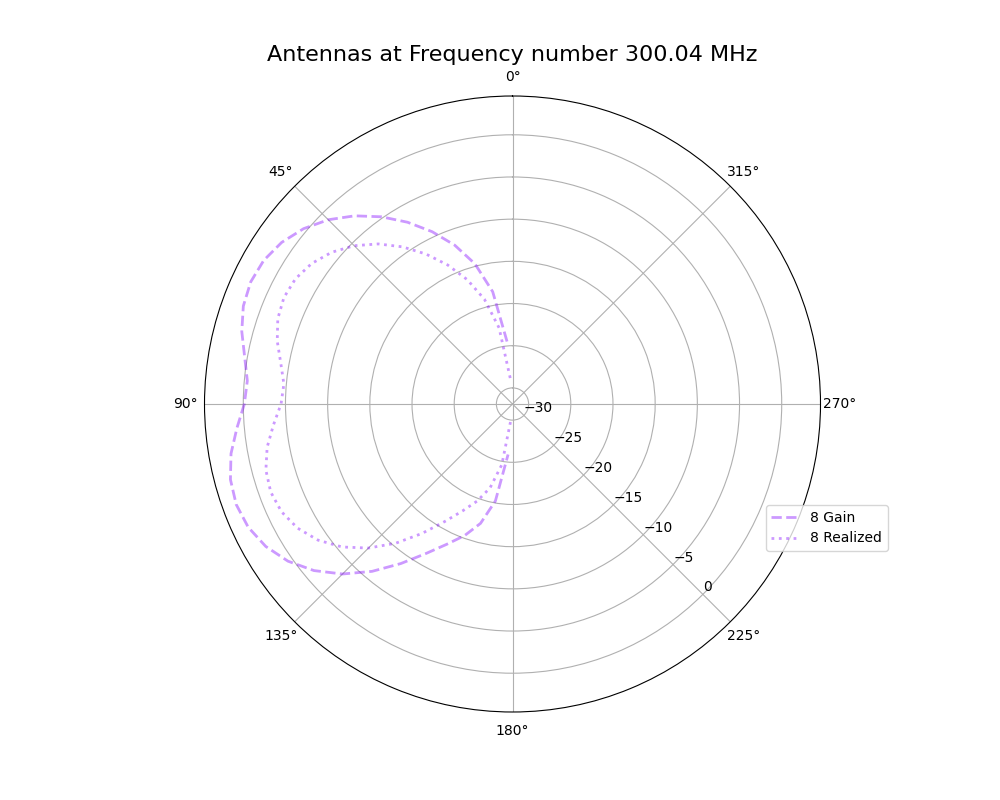
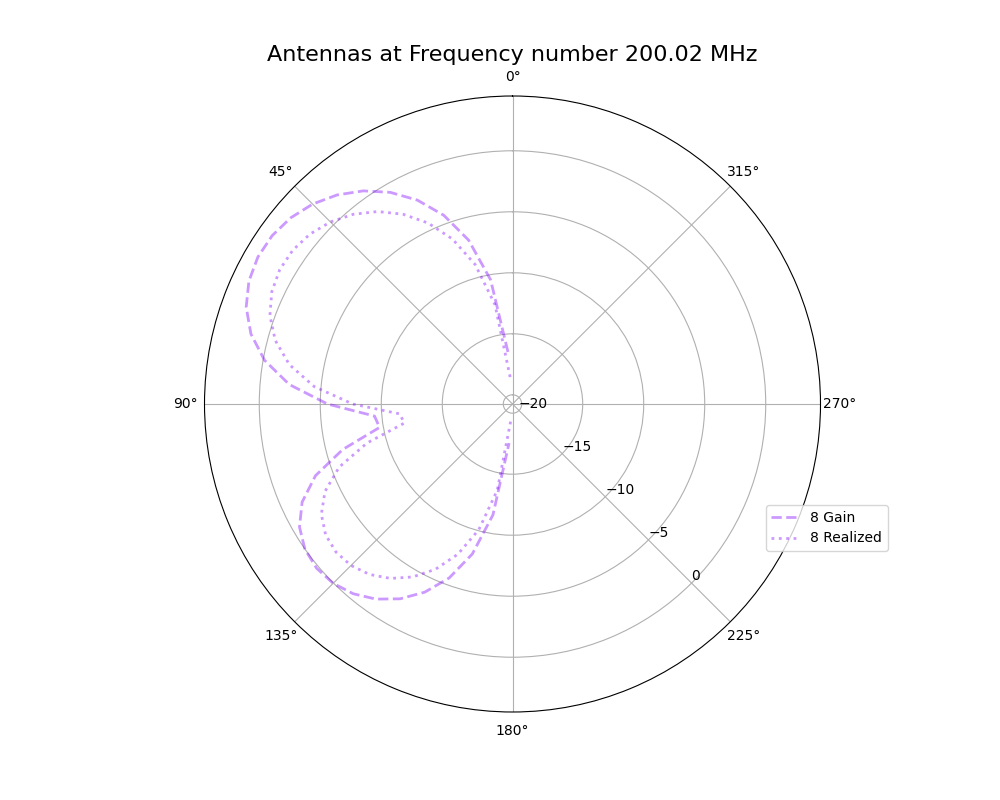
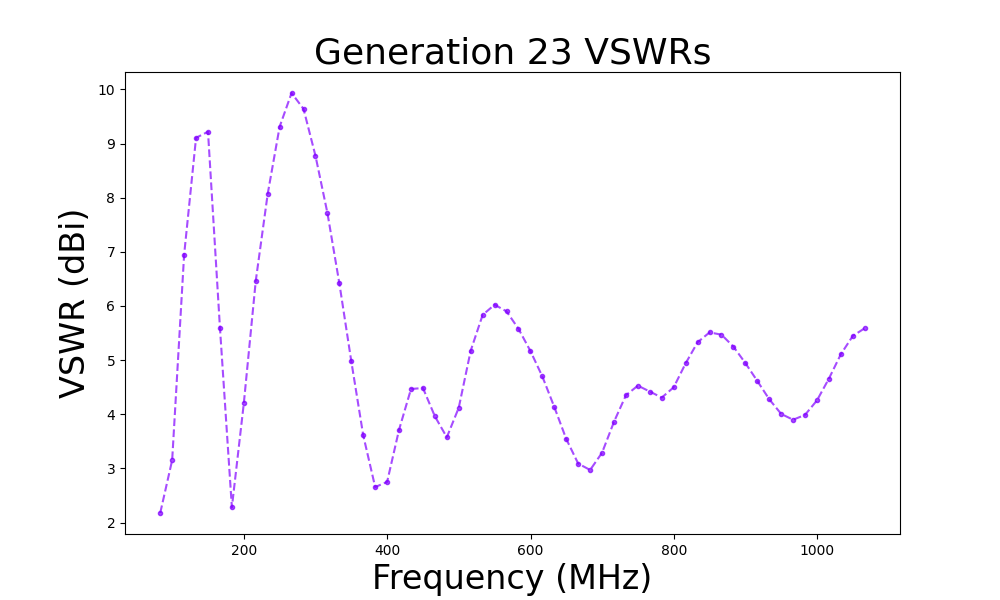
Alex M | Plots for 9/3/21 Collaboration Meeting | Here are plots I made for the meeting on 9/3/21. These plots represent a comparison of the gain and realized gain for the 23rd generation of the run being discussed in the upcoming paper. Here is a list of the plots
- Gain vs realized gain
- Polar plots of the best individual from generation 23
- S11/VSWR plots
- Shows the S11/VSWR over the bandwidth for the best individual
|
|
136
|
Fri Sep 3 14:28:55 2021 |
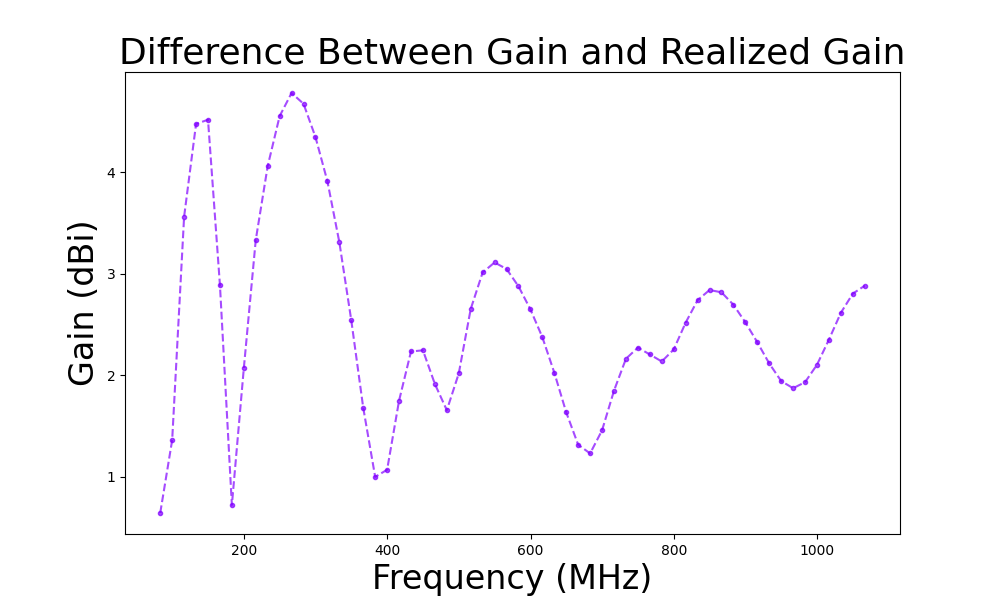
Alex M | Plots for 9/3/21 Collaboration Meeting | This ELOG post contains plots I made this week for comparing the antennas as they were evolved in the run being discussed in the upcoming paper with those same antennas when using realized gain instead of gain. These plots are preliminary, in that they should be edited before being placed in a paper (for example, VSWR is not in dBi).
Plots:
- Gain vs Realized gain
- Polar plot showing the gain and realized gain of the best individual from the run in the paper
- VSWR/S11
- The VSWR of the best individual in the run over the frequency bandwidth
- Gain differences
- The difference between the gain and the realized gain for the best individual over the frequency bandwidth
|
| Attachment 1: polar_plot_300.04.png
|  |
| Attachment 2: polar_plot_200.02.png
|  |
| Attachment 3: VSWR_plot_1811.png
|  |
| Attachment 4: mean_gain_difference_1811.png
|  |
|
137
|
Wed Sep 8 16:36:33 2021 |
Alex M | MODE Workshop Presentation | We presented at a workshop put on by the MODE collaboration. MODE is a collaboration dedicated to applying Automatic Differentiation to detector design. Here's the website: https://mode-collaboration.github.io/#:~:text=MODE%20(for%20Machine%2Dlearning%20Optimized,in%20space%2C%20and%20in%20nuclear
|
| Attachment 1: GENETIS_MODE_Presentation.pptx
|
|
148
|
Fri Mar 25 17:14:01 2022 |
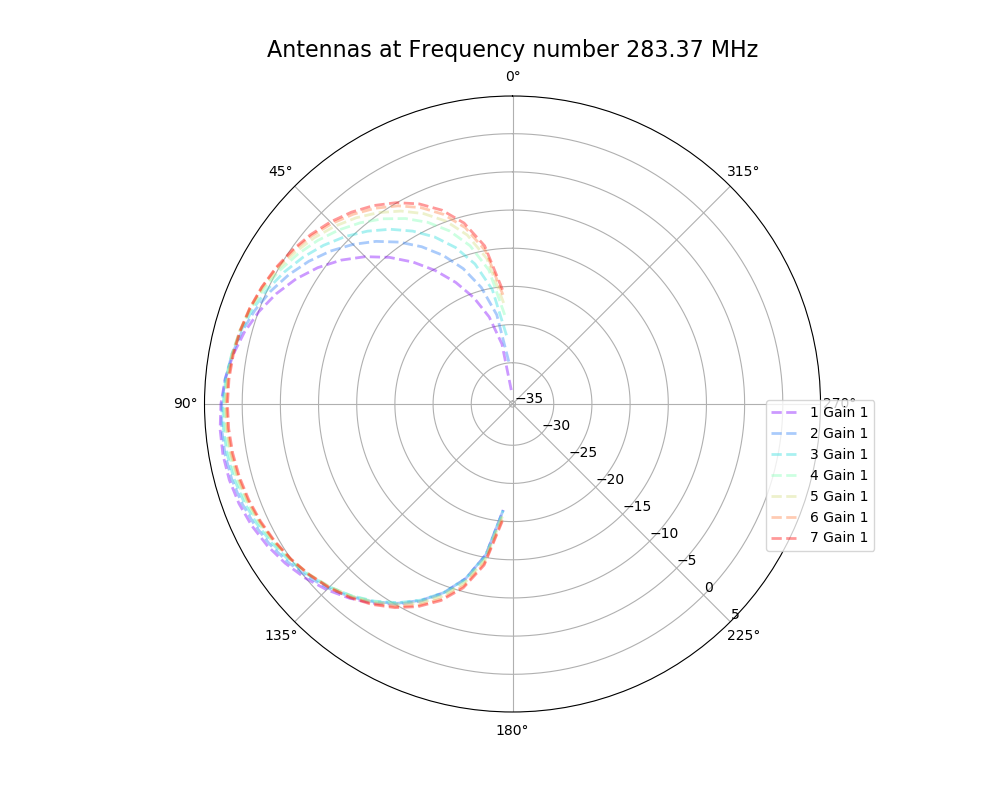
Alex M | Antenna Minimum Length Investigation | The reviewer of the paper we are trying to publish (as well as other external colleagues we showed the paper to) asked about our minimum length we implemented in the loop. Currently, we cut off the length at a minimum of 37.5 cm for each cone (minimum of 75 cm for the full cone). There is an ELOG post from Amy that presented the reasoning for this ( http://radiorm.physics.ohio-state.edu/elog/GENETIS/81 ). We initially thought that we needed a minimum because the antennas were evolving to be small (around and lower than the minimum). We thought that XFdtd was being inaccurate at lengths lower than 37.5 cm, so we set that as a minimum. To see if we can replicate any strange behavior from XFdtd, I simulated antennas at and below our minimum length and generated plots of their antennas responses. The genes are listed below, corresponding to the patterns in the plot. The results do not look unusual (that is, not dissimilar to the other bicones we have generated, including the ARA bicone) and seem to show an improved sensitivity in the upward direction for shorter bicones. The equation we used to arrive at this minimum (f = c/(4L)) might be indicative of a maximum length rather than a minimum.
| Inner radius |
Length |
Quadratic |
Linear |
2.4892,37.5,-0.00142604,0.032832
4.64522,37.5,0.00153863,-0.14004
2.4892,34.5,-0.00142604,0.032832
4.64522,34.5,0.00153863,-0.14004
2.4892,31.5,-0.00142604,0.032832
4.64522,31.5,0.00153863,-0.14004
2.4892,27.5,-0.00142604,0.032832
4.64522,27.5,0.00153863,-0.14004
2.4892,23.5,-0.00142604,0.032832
4.64522,23.5,0.00153863,-0.14004
2.4892,19.5,-0.00142604,0.032832
4.64522,19.5,0.00153863,-0.14004
2.4892,15.5,-0.00142604,0.032832
4.64522,15.5,0.00153863,-0.14004
|
| Attachment 1: polar_plot_283.37.png
|  |
|
149
|
Fri Mar 25 17:32:25 2022 |
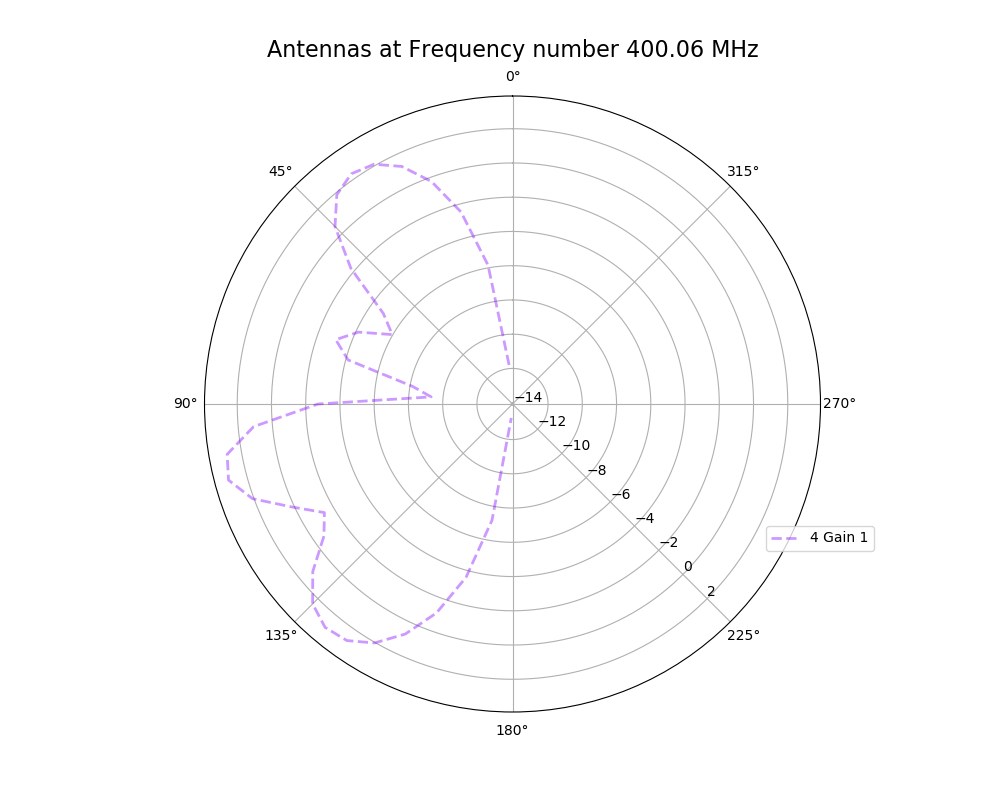
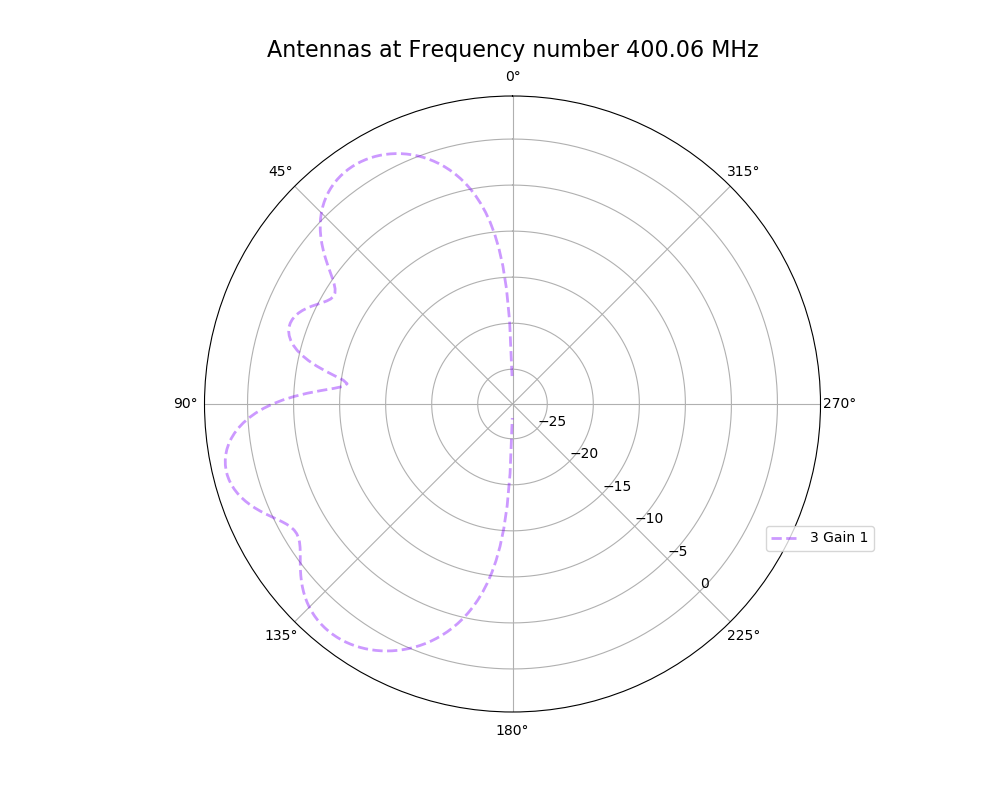
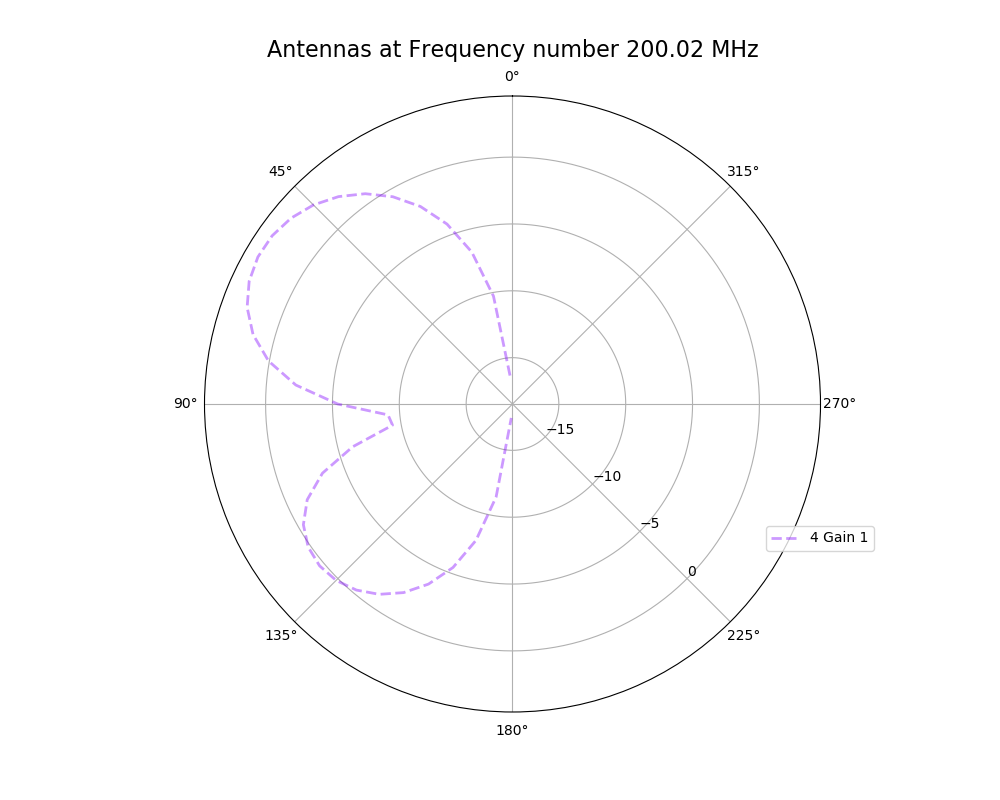
Alex M | XFdtd Step Size Investigation | The reviewer for the paper we recently submitted mentioned that our step sizes at which we are measuring the gain in XFdtd may be too large. They pointed out that there appear to be "lobes" at 400 MHz. I ran the antenna we presented in the paper through XFdtd using a step size of 5 degrees (what we've been doing) and a step size of 1 degree (the reveiwer's recommendation). Attached are antenna responses for these two different step sizes at 200 MHz and 400 MHz. Qualitatively, there are noticeable differences in the "jaggedness" of the 400 MHz plot and how extreme the minima and maxima appear, but the basic shape is preserved. We can try to do a more quantitative analysis (ex: run these through AraSim), but doing so may be more time intensive than necessary considering that AraSim may require 5 degree steps and that adding these images to an appendix may be sufficient anyway. |
| Attachment 1: polar_plot_400.06_step_5.png
|  |
| Attachment 2: polar_plot_400.06_step_1.png
|  |
| Attachment 3: polar_plot_200.02_step_5.png
|  |
| Attachment 4: polar_plot_200.02_step_1.png
| 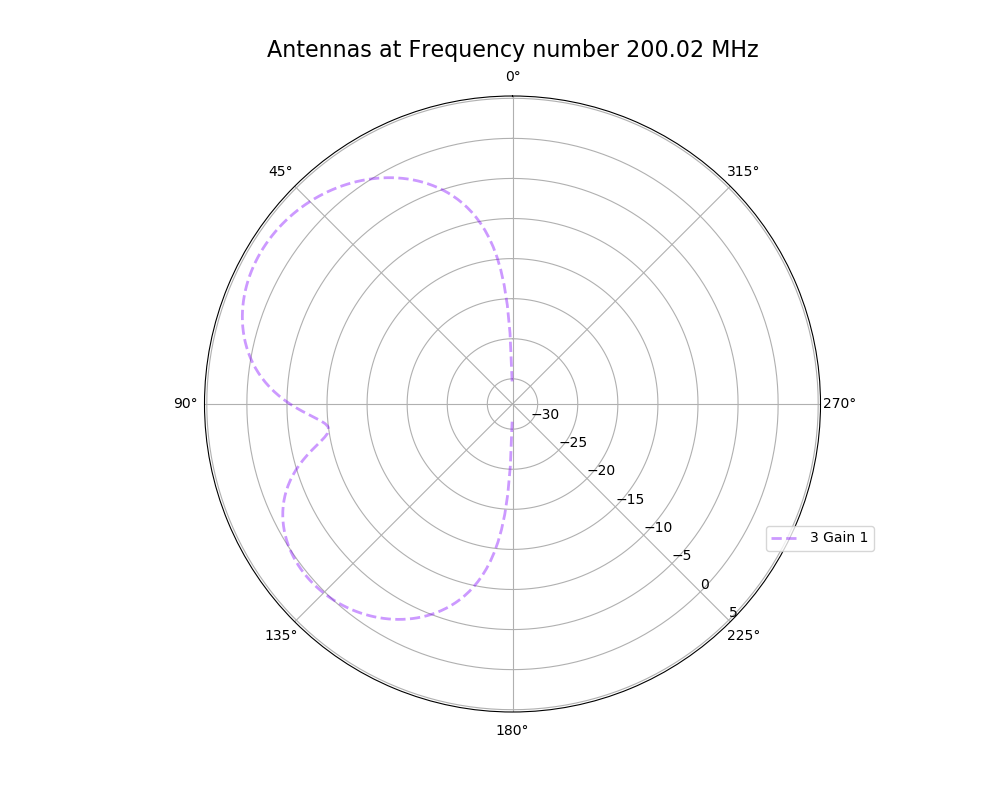 |
|
152
|
Fri Apr 8 16:07:22 2022 |
Alex M | Identical Asymmetric Lowered Length Minimum Run | We are trying to do a short run of the asymmetric bicone so that we can see how it tries to evolve the antenna when the minimum length is lowered from 37.5 cm to 10 cm. Currently, there is a problem with the loop in the asymmetric version. Attached is the run detail file. |
| Attachment 1: run_details.txt
|
####### VARIABLES: LINES TO CHECK OVER WHEN STARTING A NEW RUN ###############################################################################################
RunName='2022_04_07_Identical_Asym'	## This is the name of the run. You need to make a unique name each time you run.
TotalGens=100			## number of generations (after initial) to run through
NPOP=50				## number of individuals per generation; please keep this value below 99
Seeds=10			## This is how many AraSim jobs will run for each individual## the number frequencies being iterated over in XF (Currectly only affects the output.xmacro loop)
FREQ=60				## the number frequencies being iterated over in XF (Currectly only affects the output.xmacro loop)
NNT=30000			## Number of Neutrinos Thrown in AraSim
exp=18				## exponent of the energy for the neutrinos in AraSim
ScaleFactor=1.0			## ScaleFactor used when punishing fitness scores of antennae larger than the drilling holes
GeoFactor=1			## This is the number by which we are scaling DOWN our antennas. This is passed to many files
num_keys=4			## how many XF keys we are letting this run use
database_flag=0			## 0 if not using the database, 1 if using the database
				## These next 3 define the symmetry of the cones.
RADIUS=1			## If 1, radius is asymmetric. If 0, radius is symmetric
LENGTH=1			## If 1, length is asymmetric. If 0, length is symmetric
ANGLE=1				## If 1, angle is asymmetric. If 0, angle is symmetric
CURVED=0			## If 1, evolve curved sides. If 0, sides are straight
A=1				## If 1, A is asymmetric
B=1				## If 1, B is asymmetric
SEPARATION=0    		## If 1, separation evolves. If 0, separation is constant
NSECTIONS=2 			## The number of chromosomes
DEBUG_MODE=0			## 1 for testing (ex: send specific seeds), 0 for real runs
				## These next variables are the values passed to the GA
REPRODUCTION=3			## Number (not fraction!) of individuals formed through reproduction
CROSSOVER=36			## Number (not fraction!) of individuals formed through crossover
MUTATION=1			## Probability of mutation (divided by 100)
SIGMA=5				## Standard deviation for the mutation operation (divided by 100)
ROULETTE=2			## Percent of individuals selected through roulette (divided by 10)
TOURNAMENT=8			## Percent of individuals selected through tournament (divided by 10)
RANK=0				## Percent of individuals selected through rank (divided by 10)
ELITE=0				## Elite function on/off (1/0)

#####################################################################################################################################################
|
|
154
|
Fri May 20 14:26:39 2022 |
Alex M | GA Papers | I'm making this entry so that I can record some interesting papers we find on genetic algorithms. Feel free to update this list with links to papers and maybe make a description of what was interesting/of note in the paper.
|
|