| ID |
Date |
Author |
Subject |
|
Draft
|
Sun Apr 19 05:53:13 2026 |
Alex M | Daily Update 7/1/20 |
| Name |
Today's Update |
Plans for Tomorrow |
| Alex M |
Worked to make the frequency plots up to ~2.5 GHz. Amy said we should put a cut off for the length of the antennas based on the minimum frequency, but right now I'm not sure how to find what that minimum length should be based on the frequency (we should be using the lowest frequency for this calculation though, since it corresponds to the highest minimum length). |
I'll keep looking at how to figure out the minimum length and implement it into the loop. |
| Alex P |
|
|
| Eliot |
Implemented the asymmetric radius and separation parameter throughout the rest of the loop. Began a first test. |
Will check on and fix any errors and either tonight or tomorrow do a run for Alex to see about length convergence. |
| Leo |
|
|
| Evelyn |
Continued working on code academy, got about 3/4 of the way done |
Try to finish the code academy class before my free trial runs out! |
| Ryan |
Fixed the issues in the roulette function from Monday and integrated it into the rest of the code. seems to be running fine so far. |
Next step is to code in a user input for how many of ten individuals get selected by tournament vs roulette. Once this is complete I will try to run some tests and probably try to have the results output to a file to save results for comparisons. |
| Ben |
|
|
| Ethan |
|
|
|
|
Draft
|
Mon Apr 20 00:52:34 2026 |
Alex M | Daily Update 8/3/20 |
| Quote: |
| Name |
Update |
Plans for Tomorrow |
| Alex M |
I fixed the issues I outlined a little while ago that we needed to resolve before starting a real run. I started a real run with 10 individuals for up to 20 generations using the database for a symmetric bicone. The name of the run is Machtay_20200803_Master_Symmetric_Database_Real (whew!). Right now it's on gen 2 and plots are on drop box (see the link at the bottom). |
I'm going to keep the run going and hopefully be most of the way to 10 generations by the end of tomorrow. Julie and I also discussed some potential improvements that can be made to the loop. For one, there's some consolidation and cleaning up that should be done of the main directory. We were also speculating about a way that we could quickly see when AraSim jobs fail and rerun them in real time rather than waiting for all the jobs to finish to realize we need to rerun. |
| Alex P |
|
|
| Eliot |
|
|
| Leo |
|
|
| Evelyn |
|
|
| Ryan |
Continued working on the bash script to automate runs for paperclips. |
Finish the bash script and do the runs and start combing through the results. |
| Ben |
|
|
| Ethan |
|
|
Dropbox link: https://www.dropbox.com/home/GP_Antennas/Updates/DailyFitnessScoreImages/Machtay_20200803_Master_Symmetric_Database_Real
|
|
|
Draft
|
Mon Apr 20 02:05:11 2026 |
Alex M | Daily Update 7/23/20 |
| Quote: |
| Name |
Update |
Plans for Tomorrow |
| Alex M |
Leo and I continued working on the roulette algorithm for the asymmetric bicone to try to get the evolved generations to match the original and database ones. We went through the mutation part of the algorithm and made sure we were rrunning all of the random number sequences in the correct order (for example, we need to make sure that if we define variables A and B from a random number generator, that in both cases we define A first, then B). We also had to make sure that we were using these random sequences the same number of times (for example, we don't want to define A once in the original/database versions and twice in the asymmetric version when the asymmetric version is set to evolve symmetric antennas--this puts the random number generator "off sequence" relative to how it is in the original/database version). We tested this with the gen 0 DNA and effective volumes (which matched with the results from the original/database runs) to evolve generation 1 and got it to match. I'm currently running the loop to test this over multiple generations.
Julie and I met with Ben to talk about AREA. Yesterday, Ben was able to generate the 0th generation of individuals and then run AraSim from a job to get effective volumes. Today, we focused on editing the scripts to work for OSC job submissions (he wrote the one he used yesterday; we modified the main script today and will continue to do so). We edited it so that we could submit the main script as a job which then submits other jobs for the arasim portion and waits for those jobs to finish before continuing on (since it needs those effective volumes for its fitness score). We're going to keep incrementally fixing the main script so that it can run over multiple generations as a job submission without errors.
|
I have a doctor's appointment in the morning, but maybe Leo can continue my current run. Once it's done, optimally we would work with Julie to get everything merged so that we can start a real run (we also have to implement the changes I outlined in the ELOG post a couple days ago before we do a real run/merge--most of those are pretty simple).
Julie and I will take a look at the paperclip script Ryan's been writing to see if we can help him figure out why the roulette algorithm is giving such worse fitness scores than the tournament algorithm (~ fact of 2 worse).
|
| Alex P |
|
|
| Eliot |
|
|
| Leo |
Alex covered it above for the most part. I just worked with him today trying to correct roulette so we get the same DNA for gen 1. Just to reiterate, the last step that was hanging us up was making sure the new GA used the random number generator the same amount of times and in the same order as the old GA. After that, Alex started another run to make sure everything is running smoothly. |
Tomorrow, Alex and I will make sure the results for the first few generations match. Then, Alex, Julie and I will move on to merging. |
| Evelyn |
|
|
| Ryan |
|
|
| Ben |
|
|
| Ethan |
|
|
|
|
|
162
|
Wed Jun 8 14:45:52 2022 |
Alan S | XF Simulations | ARA bicone in ice | PowerPoint Slides |
Beam patterns with ARA bicone contained in a cylinder of air surrounded by a shell of ice.
|
| Attachment 1: XF_ARA_bicone_in_ice_and_air_column.pptx
|
|
182
|
Fri Sep 2 12:40:17 2022 |
Alan S | Ice Shell Around Bicone |
Here is a PDF with a summary/log of my work trying to integrate an ice shell surrounding the bicone antennas in the GENETIS loop. I made gain patterns of the ARA bicone with the ice shells and without them, showing the impact of the ice on the antenna's gain. Having an ice shell changes these patterns, which are also dependent on the radius of the shell. I showed that convergence on the gain patterns and expected features start ocurring for shells with radii larger than 10 meters. I also keep track of the computation time which increases with bigger shells.
Note: I also add PowerPoint slides that contain all the graphs that I made. The PDF does not contain some of those since I didn't think they were coherent with my write-up, but I may be making an omission.
|
| Attachment 1: XF_ARA_bicone_in_ice_and_air_column.pptx
|
| Attachment 2: Far_Zone_Gain_of_ARA_Bicone_insice_Ice.pdf
|
|
146
|
Fri Feb 11 16:34:54 2022 |
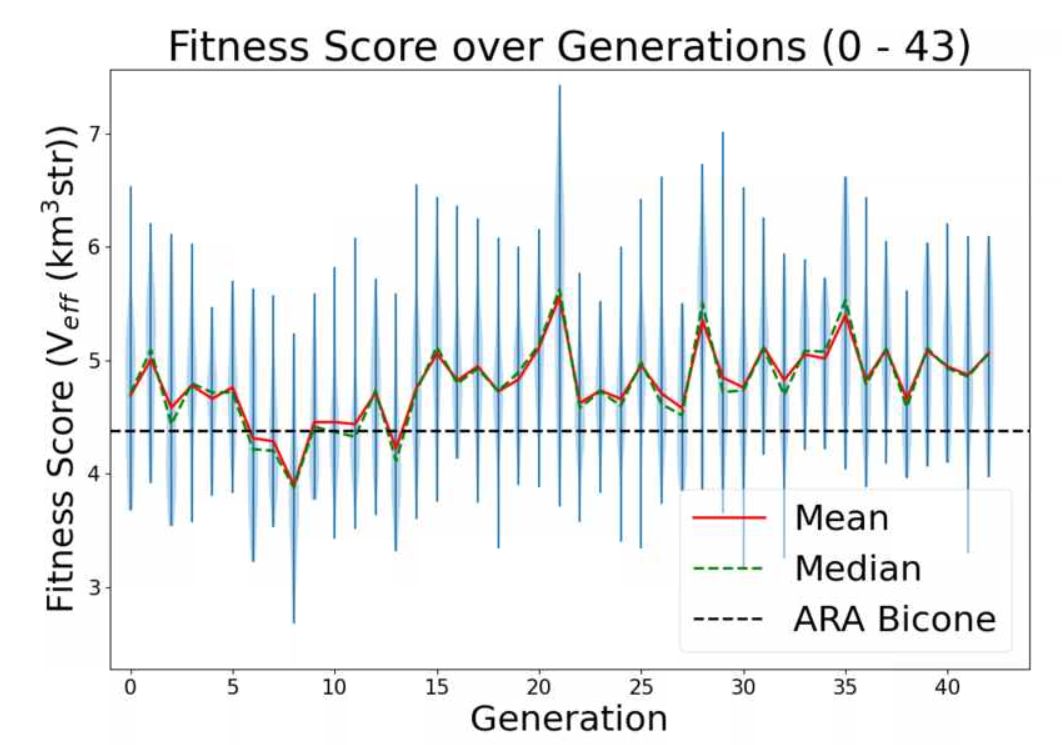
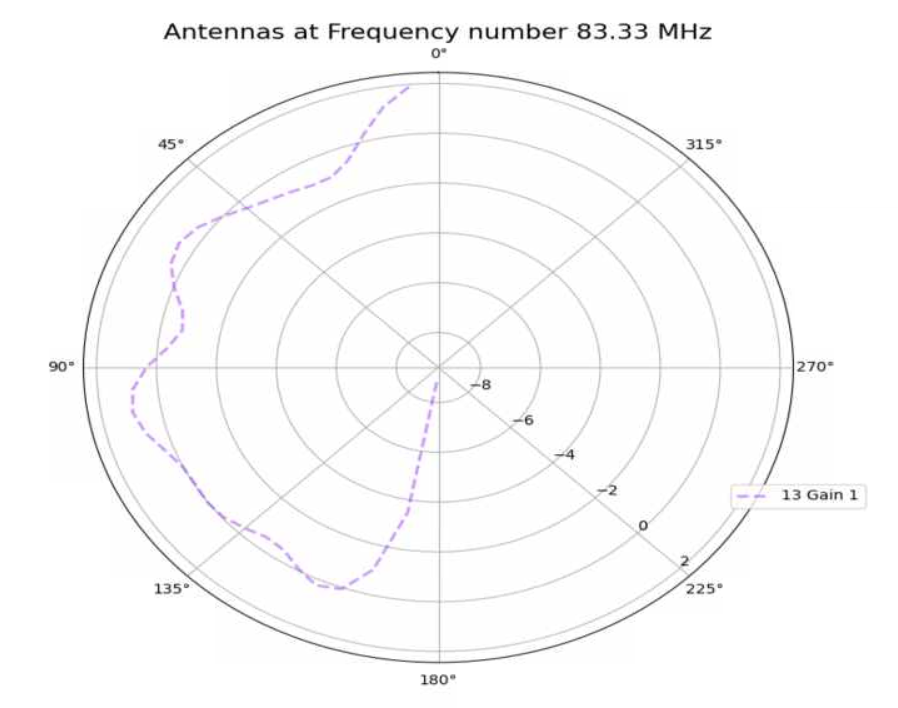
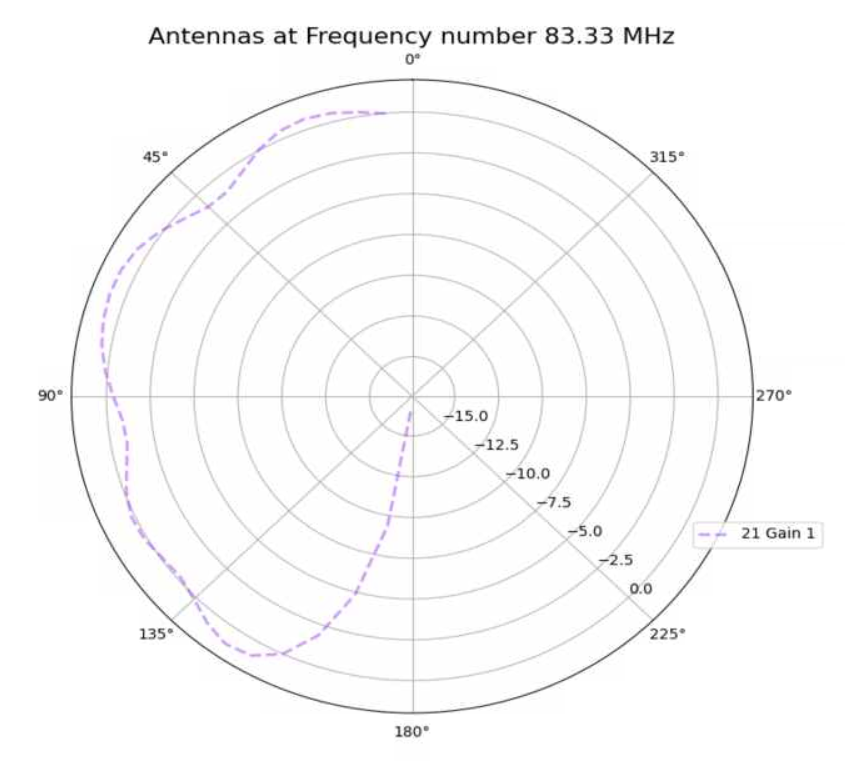
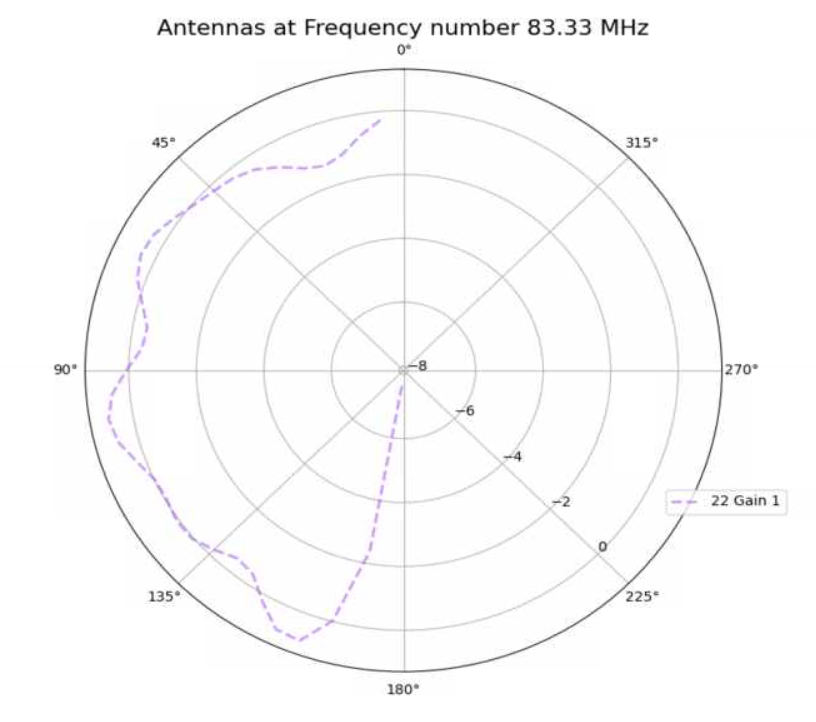
Aidan Snyder | AREA - frequency linear dependence correlation test run - 01/18/2022 |
- Run Type
- Run Date
- Run Name
- Why are we doing this run?
- to see if the linear dependence on frequency was properly implemented
- What is different about this run from the last?
- attempted to evolve gain pattern as a linear function of frequency
- Symmetric, asymmetric, linear, nonlinear?
- Number of individuals (NPOP)
- Operators / Selection methods used (% of each)
- roulette crossover 50%
- roulette mutation 16%
- tournament crossover 18%
- tournament mutation 16%
- Are we using the database?
|
| Attachment 1: Screenshot_2022-02-11_164514.png
|
 |
| Attachment 2: Screenshot_2022-02-11_164136.png
|
 |
| Attachment 3: Screenshot_2022-02-11_164252.png
|
 |
| Attachment 4: Screenshot_2022-02-11_164406.png
|
 |
|
151
|
Fri Apr 8 16:06:31 2022 |
Aidan Snyder | AREA - frequency linear dependence correlation test run - 04/05/2022 |
- Run Type
- Run Date
- Run Name
- Why are we doing this run?
- to see if the linear dependence on frequency was properly implemented
- What is different about this run from the last?
- Under closer examination, the previous run of AREA appeared to not linearly depend on frequency, so we recompiled the GA in order to fix this
- Symmetric, asymmetric, linear, nonlinear?
- Number of individuals (NPOP)
- Number of neutrinos
- Operators / Selection methods used (% of each)
- roulette crossover 50%
- roulette mutation 16%
- tournament crossover 18%
- tournament mutation 16%
- Are we using the database?
- Result
- There is a problem with how the GA has assigned the Veff values, resulting in many individuals being assigned zero Veff, however the linear dependence seems to have been implemented successfully
Note: We also ran a run called 20220405fahimi5run1, which was a short test run with a very low amount of individuals and neutrinos which seemed to work fine; as in the linear dependence seemed to work. |
|
153
|
Tue Apr 19 17:46:07 2022 |
Aidan Snyder | AREA - Short run testing stringReplacement2.py - 04/19/2022 |
- Run Type
- Run Date
- Run Name
- Why are we doing this run?
- Check to see if stringReplacement2.py changes were successfull
- What is different about this run from the last?
- added below code in order to create a fitness file inside of each generation to display the fitness scores for just that generation, as opposed to just having one big file full of all the generations.
f2 = open(source + "/" + "gen_{}".format(gen) + "/fitnessFile_gen_{}".format(gen) + ".txt", 'a')
f2.write(','.join(mean_Veff_array) + "\n")
f2.close()
- Symmetric, asymmetric, linear, nonlinear?
- Number of individuals (NPOP)
- Operators / Selection methods used (% of each)
- roulette crossover 50%
- roulette mutation 16%
- tournament crossover 18%
- tournament mutation 16%
- Are we using the database?
|
|
Draft
|
Sun Apr 5 15:07:50 2026 |
Aidan Snyder | AREA - frequency linear dependence correlation test run - 04/05/2022 |
- Run Type
- Run Date
- Run Name
- Why are we doing this run?
- to see if the linear dependence on frequency was properly implemented
- What is different about this run from the last?
- Under closer examination, the previous run of AREA appeared to not linearly depend on frequency, so we recompiled the GA in order to fix this
- Symmetric, asymmetric, linear, nonlinear?
- Number of individuals (NPOP)
- Number of neutrinos
- Operators / Selection methods used (% of each)
- roulette crossover 50%
- roulette mutation 16%
- tournament crossover 18%
- tournament mutation 16%
- Are we using the database?
- Result
- There is a problem with how the GA has assigned the Veff values, resulting in many individuals being assigned zero Veff, however the linear dependence seems to have been implemented successfully
Note: We also ran a run called 20220405fahimi5run1, which was a short test run with a very low amount of individuals and neutrinos which seemed to work fine; as in the linear dependence seemed to work. |
|
Draft
|
Wed May 20 10:58:38 2020 |
| |
Today's Summer 2020 daily update:
As a note, today OSC was down so productivity was more limited
| Name |
Update for Today |
Plans for Tomorrow |
| Alex M. |
Mostly just wrote more on the paper in the Genetic Algorithm section. I added some citation that we used in ICRC but there are still more places that should have citations.
|
I might check tonight when OSC is back up to try to push in more updates to the loop because I wanna get Evelyn and Ryan started on running the loop. Putting in those fixes is a big priority because we want to be able to correct the potential issue with XF simulation folders being overwritten and thus uan data not corresponding to the write individuals. The two big things for me in the loop are getting the simulation data to save correctly (and also putting that in the database) and testing that we can replicate results using the specific seed. I'll probably only focus on loop stuff tomorrow.
|
| Alex P. |
Got up before OSC was down to check progress of overnight run, it seems to have worked but I noticed a problem with the database that it wasn't writing to it probably due to a permissions issue but I would have to run another time to see. Shouldn't have affected data but just the use of the database. Run got up to 8 generations with non-zero fitness score which is positive and seems to have fixed the error we originally encountered. Talked to Eliot about pointers and possible errors but was unable to look at the specific error because it is on OSC.
|
Tomorrow plan is to continue to work on database functionality and continue run to get more generations, also want to add the ability to add more plots than just the fitness score to the dropbox automatically. Plots: upload all plots (Fitness, LRT, vEff), remove legend, upload penalized red/green plot too, take off legend, add units to Fitness |
| Leo |
|
|
| Eliot |
Read about pointers and vectors in C++. Talked to Alex P a bit, and have some ideas of things to change to get the GA running. Began reading about antennas. Mostly a down day due to OSC being down.
|
Will implement changes to GA and continue familiarizing myself with how XF reads these values.
|
| Evelyn |
|
|
| Ryan |
|
|